
Clear vs Colourless : It Matters
I don’t really think of myself as a writer.
But working with students, helping them build clear, expressive tasting notes that they can use to communicate with clients, guests, and other drinks professionals, has made me increasingly conscious of language — and the way the words we choose shape how we taste and talk about drinks.
One example: “clear” and “colourless” are not interchangeable. A wine can be perfectly clear yet deeply coloured, while a spirit can be colourless but hazy. It sounds pedantic until you realise that accurate language leads to accurate observation, and accurate observation leads to better tasting, better writing, and ultimately better understanding and communication. Whether studying for WSET or simply trying to describe what’s in the glass, language does matter.
The words have different meanings. Clarity is about transparency. A clear wine or spirit contains no visible particles suspended within it. If particles are present, they scatter light and reduce clarity, creating a hazy appearance. Colour meanwhile is the visual perception produced when different wavelengths of light are absorbed, transmitted, or reflected by compounds and pigments within a wine or spirit—such as polyphenols, oxidation products, or added colourants. The light stimulates the eye’s photoreceptors and are then interpreted by the brain as colour.
Hazes in spirits are usually due to the presence of insoluble oils, fatty acids, esters, or other congeners becoming insoluble under certain conditions notably cooling or dilution.
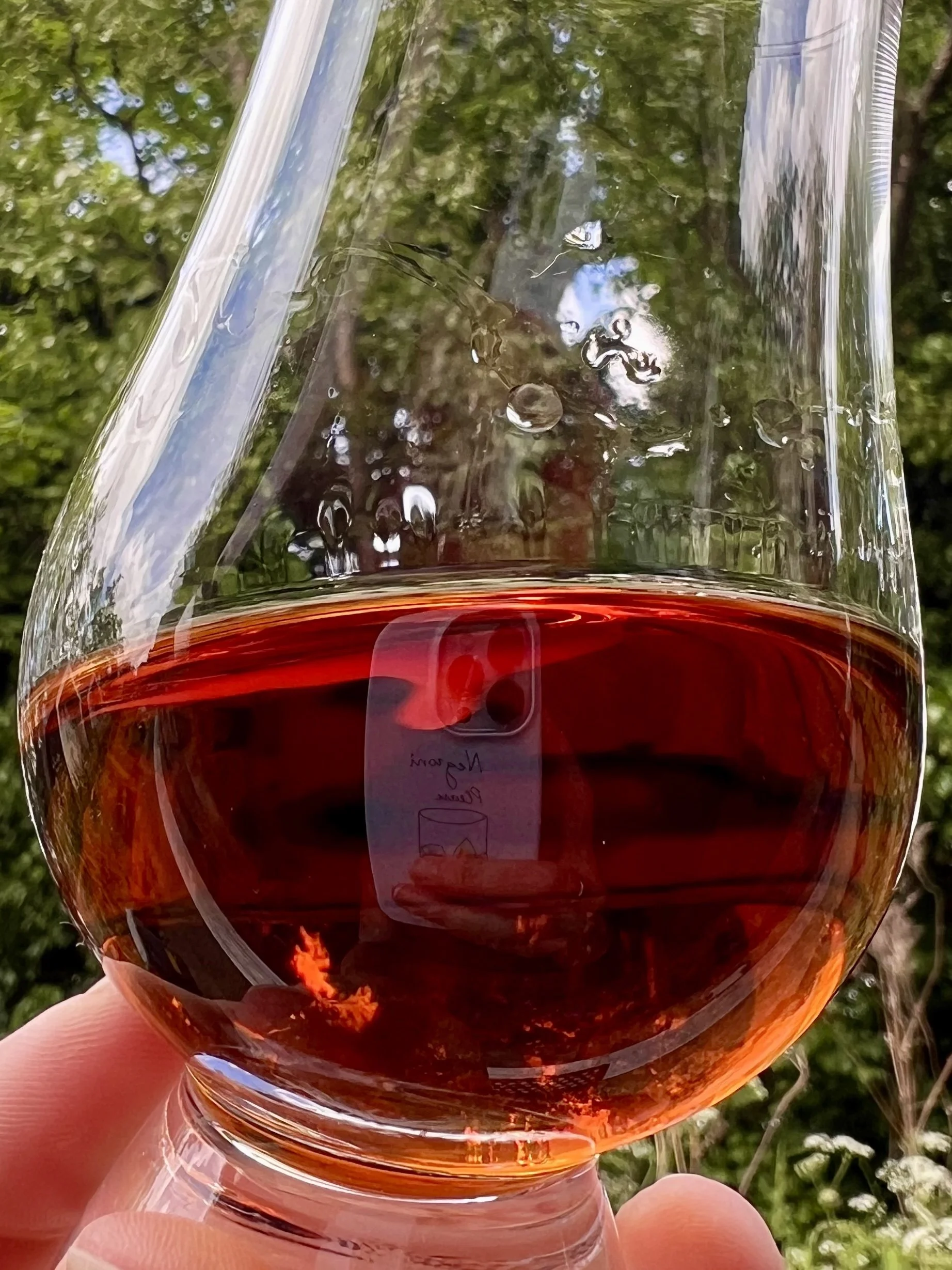
Martell’s VSOP Cognac is clear and bright, the result of chill-filtering to ensure no haze.
A distiller can prevent hazes from forming by chill-filtering the spirit before bottling. The spirit is cooled, typically to between 4°C and -10°C, causing compounds that might otherwise create a haze to precipitate out of solution. The chilled spirit is then passed through a fine filter, removing the precipitate. The result is a spirit that remains clear even when stored at low temperatures or diluted with water. Most spirits are filtered in this way to ensure a consistently clear and bright appearance, as this is generally what consumers expect, prefer, and associate with quality.
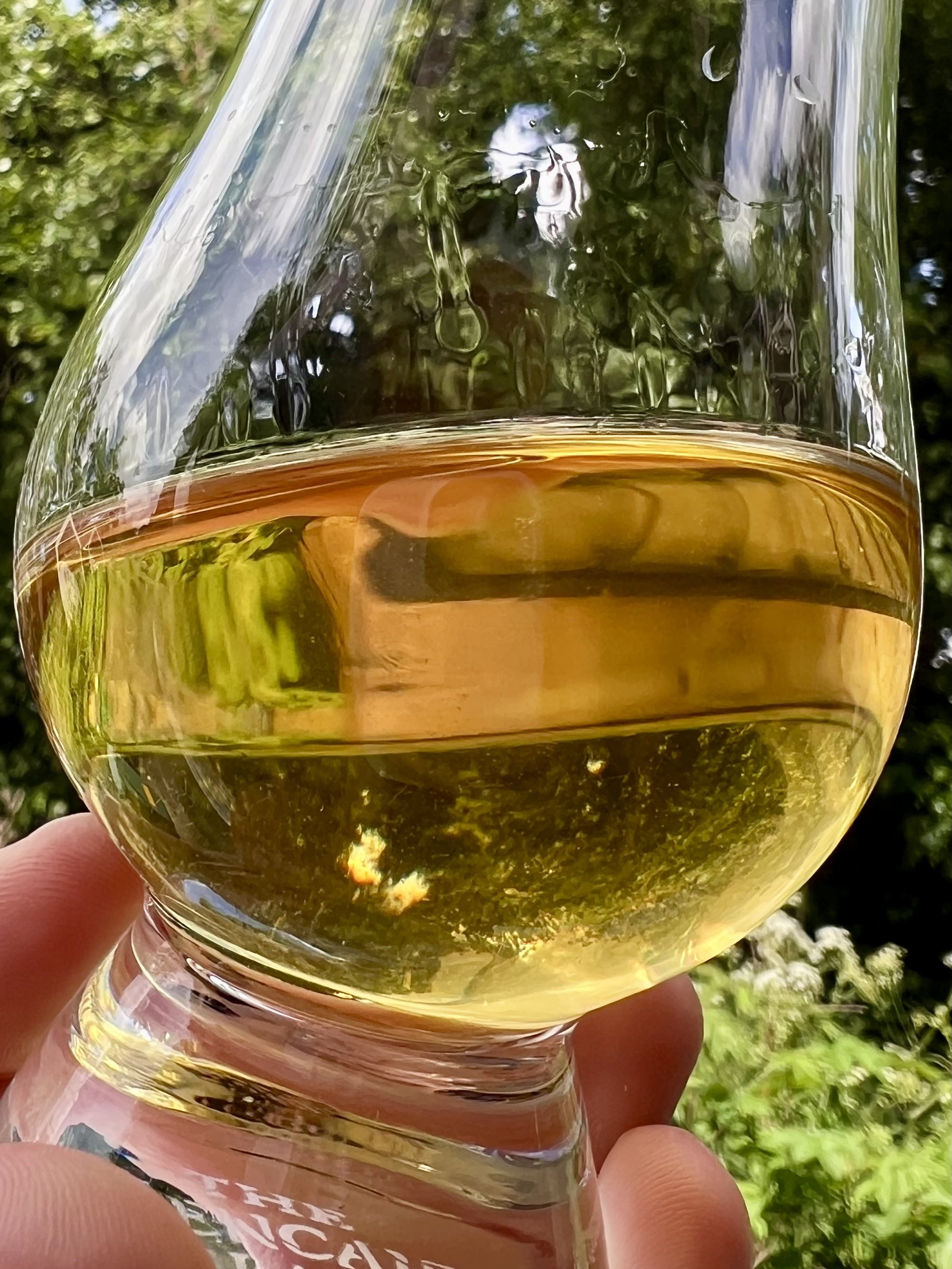
Fanny Fougerat Cognac XO showing a light haze, the result of the decision not to chill-filter prior to bottling.
Sometimes, however, a haze is perfectly acceptable to distillers and consumers who argue that chill-filtration removes compounds that contribute not only to haze formation but also to a spirit's aroma, flavour, and texture. Some take the view that chill-filtration is an unnecessary intervention, preferring to present the spirit in a form that is closer to how it emerged from maturation or production. As a result, a distiller may choose not to chill-filter their spirit.
For example, Fanny Fougerat does not filter her Cognacs, resulting in a light haze (the adjacent image tries to demonstrate this). Such spirits are often labelled as "non-chill filtered", signalling to the consumer that they can expect the spirit to throw a haze, particularly if stored in the cold or ice or water added when serving.
In other cases, however, a haze may indicate a fault. If its presence cannot be explained by production choices or is inconsistent with the expected style of the spirit, it may suggest inadequate process control, instability during storage, or, more rarely, microbial contamination. Context is therefore key: the same haze that is accepted, or even celebrated, in one spirit may be considered a defect in another.
Whether intentional or not, the presence of a haze is a valid observation when assessing a spirit, which is why I encourage students using the WSET's Systematic Approach to Tasting to comment on a spirit's clarity. One issue I frequently encounter, however, is students confusing clarity with colour, so that "clear" becomes synonymous with "colourless". But, actually, these are two separate observations. A spirit can be brilliantly clear while displaying a deep amber colour, just as a colourless spirit can be hazy. Clarity describes how transparent the spirit is; colour describes, well, the colour of the liquid.
Spirits emerge from the still as colourless because these substances responsible for colour, are non-volatile and are left behind in the wash. Colour therefore is added post-distillation, either through maturation in oak casks or, in some categories, through the addition of permitted colouring agents such as caramel colour (E150a). While many spirits are colourless, spirits can display a wide spectrum of colours, from the pale lemon of a tequila reposado to the deep amber of a long-aged rum.
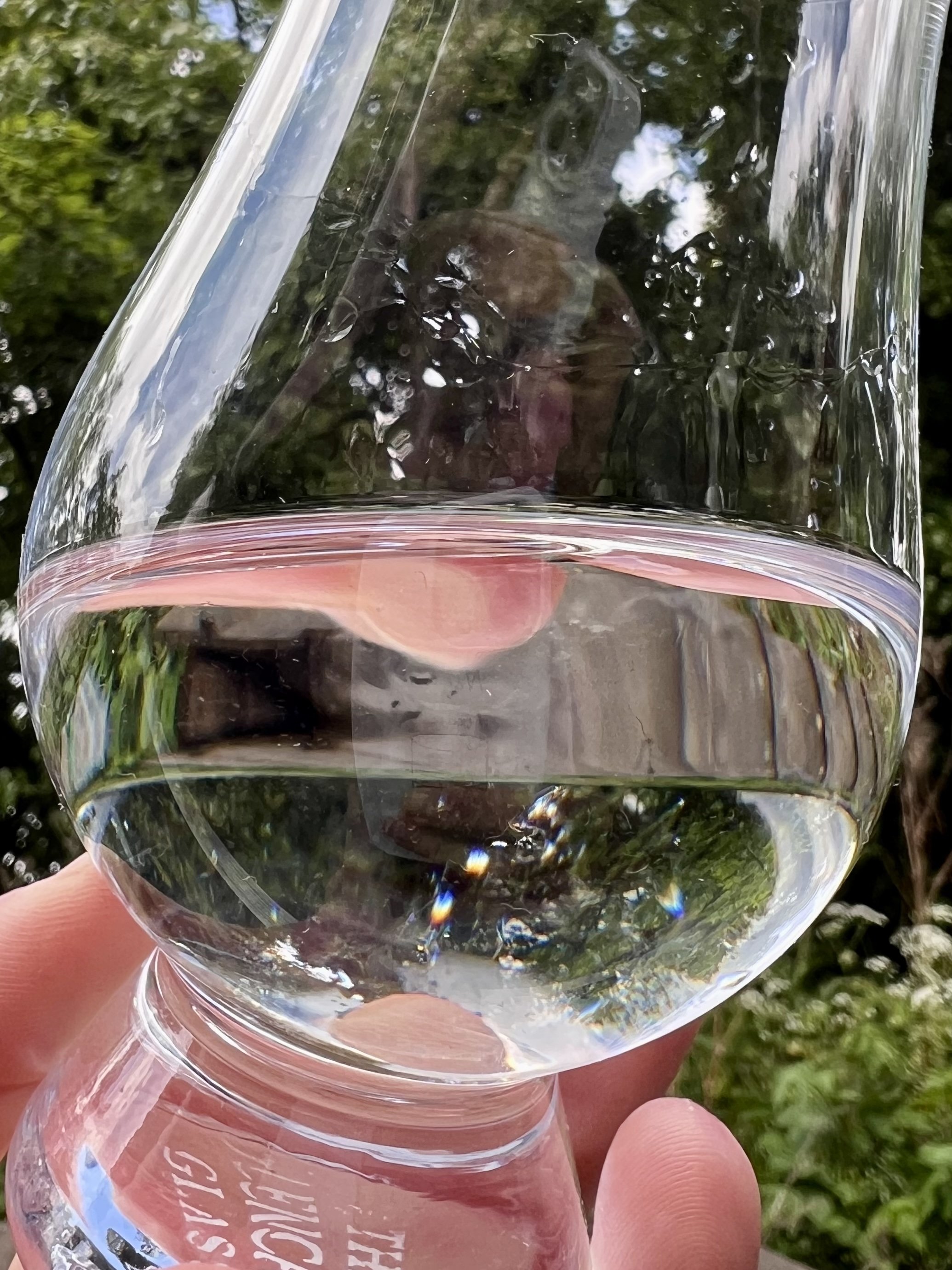
Plymouth Gin, it is clear with no haze, and it is colourless, with no colour.
When assessing colour, students must focus on its hue. Colour can provide clues about production methods, maturation, and style, but it should not be confused with clarity.
This distinction becomes particularly important at Level 3. There are no marks awarded for assessing clarity in the tasting exam, but one mark is available for describing the spirit's colour accurately. If a student writes "clear" instead of "colourless", they will not be awarded the mark because it is not a sufficiently precise description. A spirit can be clear and gold, clear and amber, or clear and brown. By only describing the spirit as "clear" and not “colourless” the student has failed to communicate its colour to the examiner.
A useful way to approach appearance when tasting is to ask yourself two simple questions. First: can I see through it clearly, or is it hazy? This is your clarity assessment, and any observation is best recorded in the “other observations” field. Second: what colour is it? Consider whether the spirit is colourless, lemon, gold, amber, brown, or another appropriate hue, and record this in the colour field. Keeping these two observations separate helps ensure greater accuracy and prevents the common mistake of using “clear” as a substitute for describing colour.
But learning to separate clarity from colour has value far beyond the marks available. It develops the habits of observation, precision, and objective description that underpin good tasting practice. The goal is not simply to collect points on an exam paper, but to train yourself to look carefully and describe what you see accurately.
So perhaps this isn't really a post about haze, chill-filtration, or even spirits at all. It's a post about paying attention.
The difference between "clear" and "colourless" may seem trivial, but it reflects a broader principle that applies to tasting at every level. The more carefully we observe, the more accurately we can describe what is in the glass. And the more accurately we describe it, the more effectively we can communicate with others.
Good tasting is not simply about identifying aromas and flavours. It is about translating sensory experience into language. Sometimes that starts with something as simple as recognising that a spirit can be clear without being colourless, and colourless without being clear.
